Agnese Bērziņa and Doles tējas
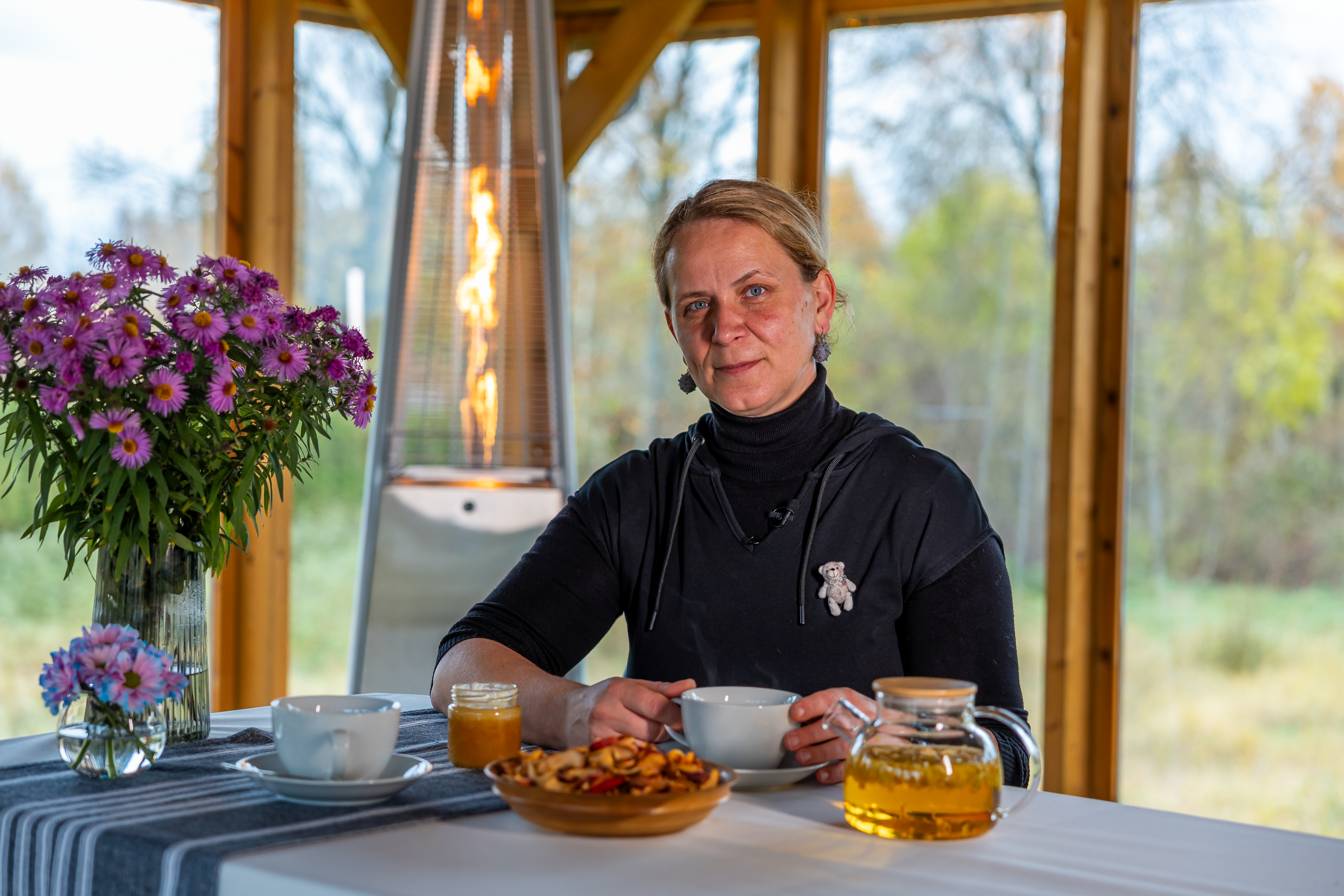
Agnese Bērziņa, owner of “Doles tējas” (Dole teas), together with her family and inspired by the power of Latvian nature and traditions, runs her business on the picturesque Dole Island in Salaspils municipality, next to the Daugava Museum. In this scenic nature park they farm with care for the environment – growing medicinal plants, producing “Doles tējas” and welcoming guests both in their little shop and in the Celebration Pavilion (Svētku paviljons), where celebrations are also held. Educational tours give visitors the chance to get to know the diverse world of teas more closely.
How did “Doles tējas” start?
Our story began in 2011, when we were looking for a place for a herbal tea and medicinal plant garden, which needed a large area. We chose this place on Dole Island and started everything from scratch, because at first there was nothing here. This year our company is already eight years old!
“Doles tējas” is a family business. What challenges does that bring?
As I joke, a family business means that everyone works but mum gets the salary. But seriously, sometimes it is very hard, but also very valuable, because we are building our future together.
Does your family pay attention to environmentally friendly farming in its daily work?
Of course! We are in a nature park – the whole of Dole Island is a nature park, and here it is simply not possible to do otherwise. You have to live in harmony with the environment and nature. That is why we have always been nature-friendly – for example, we sort our waste. When growing teas and medicinal plants, we do not use chemicals, and in the garden we use only organic fertiliser.
Does working with herbal teas mean that you also follow a healthy lifestyle yourselves?
On the whole, yes, our family tries to lead a healthy lifestyle. But it is not an end in itself – farm work requires strength and endurance, so we are physically active and take care of our diet. I have to admit that during the season we often “sin” when it comes to sleep and rest.
How would you comment on how scientifically proven the effect of medicinal teas is, and how much of it is simply belief that a particular herbal blend will help with a health problem?
Many medicines known today were originally borrowed from the plant world. The main difference between pharmacy medicines and our teas is that drug manufacturers use the active substances, which we offer in a natural form. If plants are used correctly, they can help balance the body’s processes, and there is plenty of research around the world that confirms this.
Your location is not “on the way” for everyone. To get to “Doles tējas” and the “Svētku paviljons”, people have to head purposefully towards Dole Island. What are the biggest challenges and benefits?
The biggest challenge is to create an attractive offer that motivates people to come. In this sense, you could say that we create the flow of tourists to us ourselves. The biggest benefit is that the people who come to us are genuinely interested in what we offer.
Tell us about life on Dole Island!
As far as I know, Dole Island is the only inhabited island in Latvia, and life on the island has its own peculiarities. Technically it is now a peninsula – it has only been like that for the last 50 years, because before that all traffic was by water. That “island dweller gene” is reserved, so at first this community is not very open and friendly. It took ten years until, as my husband and I joke, the neighbours started greeting us properly. But wonderful people live here, which I have realised as I have got to know them better. Life on Dole Island is interesting, because there is water all around, it is windy, and although we are close to Riga, it feels like real countryside.
What is your best recipe for fighting seasonality in tourism?
In the off-season we actively prepare for the season! Our season is long – from mid-April to Christmas, when demand is highest. There is plenty of work in winter too – we sort out paperwork, attend training, plan the new season and, of course, also try to rest by going on a trip to get new impressions.
How do you understand what a tourist wants?
A guest wants an experience – to touch, smell, feel and taste. This experience should take them for a moment into another, unfamiliar environment and surprise them. People travel to learn and experience something new.
Why is it better to cooperate rather than compete in tourism?
Cooperation makes it possible to create more attractive offers, because no tourism business can offer a full range of services in one place. But our experience shows that cooperation has to develop naturally – between like-minded people on the same wavelength. As the saying goes, “you can’t force someone to love you”!
How does cooperation with local tourism service providers work?
I believe that a tourism offer must be friendly to the local community so that it does not disturb neighbours and local residents. We are lucky with the tourism businesses around us, with whom we cooperate every day and who share a similar view. On Dole Island our joint offer is a quiet holiday in nature for people who value the peace and quiet of nature. People from the city can come to Dole, walk in the forest, visit the Daugava Museum, stay overnight in a nice place, drop in on us for tea and buy both our teas and other local producers’ products, which we offer in our shop.
Find out more about “Doles tējas” here:
Website: www.dolestejas.lv
Phone: +371 25 772 734
Address: Dole Island, next to the Daugava Museum. You can find it by entering “Doles tējas” in your navigation app or the address “Ziediņi”, Salaspils novads, LV2121.


Photos:
1. Naturally grown and hand-picked teas.
2. Visitors to the farm are offered tastings, tours and a little shop, where you can buy herbal teas, honey products and works by local craftspeople.
3. Svētku paviljons (Celebration Pavilion) – a venue for smaller and larger parties in the Dole Island landscape.
The host stories are created within the project “Improving the competitiveness of the Riga region tourism area with sustainable and digital solutions” (No. 23-00-A019.332-000002), implemented by the association Pierīgas Partnerība in cooperation with the local action groups Partnerība Daugavkrasts, Biedrība "Gaujas Partnerība", Zied zeme, Biedrība Ropažu Salaspils partnerība, Stopiņu un Salaspils Partnerība, Jūras Zeme and the Riga Region Tourism Association, under the sub-programme “Inter-territorial and transnational cooperation” of the Latvian Rural Development Programme 2014-2020 of the European Agricultural Fund for Rural Development.
More about the project: https://ej.uz/TURISMA_SADARBIBA
